Chapter 04
Coastal Ecology & The Corolla Wild Horses
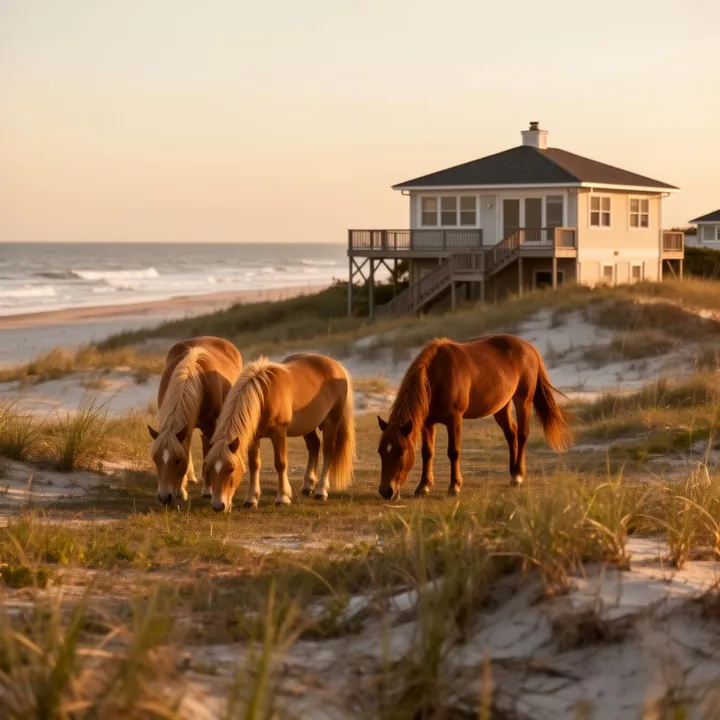
Carova Beach's wild horse herd is not a marketing talking point. It is a federally acknowledged ecological and cultural resource that has shaped this stretch of coastline for approximately 500 years, and it is managed under enforceable county and federal protections that every property owner must understand before closing. For buyers, the horses are simultaneously a compliance obligation, a long-term asset, and one of the most authentic experiential differentiators available anywhere on the East Coast.
The Herd: Verified Facts
The Corolla wild horse herd — ranging across the 4x4 area including Carova, North Swan Beach, and Swan Beach — consists of Colonial Spanish Mustangs whose lineage has been confirmed through DNA testing conducted in 1992 and 2007 by equine geneticist Dr. E. Gus Cothran of Texas A&M University. The horses are registered as Colonial Spanish Mustangs and listed as a critically endangered breed by both the American Livestock Conservancy and the Equus Survival Trust.
As of 2024, the herd population stands at approximately 100–111 horses, ranging across roughly 7,544 acres of federal, state, and private land north of Corolla. The horses were designated as the North Carolina State Horse in 2010. The 7,544-acre sanctuary is bounded by a sound-to-sea fence at the end of the hard road and the Virginia state line — established in 1996 after 20 horses were killed or injured by vehicles on NC-12 following the road's paving in 1985.
The herd is managed exclusively by the Corolla Wild Horse Fund (CWHF), a 501(c)(3) nonprofit established in 1989. CWHF provides 24/7 emergency response, veterinary oversight in partnership with NC State University College of Veterinary Medicine and Texas A&M, contraceptive management of mares over 10 years old, and operates a rescue facility at the Betsy Dowdy Equine Center in Grandy for horses removed from the wild due to illness or injury.
Source: Corolla Wild Horse Fund; DNA testing confirmed by the Horse of the Americas Registry; NC General Assembly — state horse designation 2010
⚠ The 50-Foot Ordinance: Non-Negotiable
Currituck County ordinance requires all persons to maintain a minimum 50-foot distance from the wild horses at all times. This is not a suggestion. It applies to:
- Homeowners and permanent residents
- Short-term rental guests and their visitors
- Beach drivers and vehicle passengers
- Pets on leashes
Feeding, petting, luring, or intentionally approaching the horses is strictly prohibited. The published fine is $500 per incident.
As a property owner operating a short-term rental, you are responsible for communicating these requirements to every guest before arrival — in your booking confirmation, your house manual, and your pre-arrival messaging. Non-compliance by guests creates direct liability exposure and reflects on your operating record with Currituck County.
Source: Currituck County ordinance; visitcurrituck.com horse protection guidelines
The Horses as a Real Estate Asset
The wild horse herd is Carova Beach's most powerful STR marketing differentiator. No comparable property in a fully developed Outer Banks market can offer it. Properties with documented horse-viewing access — particularly oceanfront and semi-oceanfront positions where horses regularly graze — command measurable rate premium in active STR listings.
The correct positioning is not "beach house near wild horses." It is "wake up to Colonial Spanish Mustangs grazing outside your window on a federally protected stretch of Atlantic coastline." That is a genuinely scarce experience, and the global STR market is moving aggressively toward experiential stays. Carova has a structural advantage in that category that Corolla, Duck, and Kill Devil Hills simply cannot replicate.
For the Competent Romantic, the horses are the experiential core of the ownership thesis. For the Contrarian Capitalist, they are a durable demand driver embedded into a supply-constrained asset. For the Legacy Builder, they are a 500-year feature of this landscape that will outlast every development cycle.
Beyond the Horses: The Full Ecological Picture
The wild horses are the most visible element of a broader ecological environment that constitutes a permanent, undevelopable buffer around Carova Beach private property — and a structural feature of the market's long-term value.
Currituck National Wildlife Refuge — 4,570 acres
Established in 1984, the Currituck National Wildlife Refuge consists of six separate units spanning the northern Outer Banks between Corolla and the NC/VA state line. The refuge is managed by the U.S. Fish & Wildlife Service to protect endangered species habitat and migratory bird corridors. No buildings or developed facilities exist on the refuge — by design and by mandate. Key species include the federally endangered piping plover and the loggerhead sea turtle, both of which nest on refuge beaches and dunes.
Currituck Banks National Estuarine Preserve — 965 acres
Adjacent to the NWR, the Currituck Banks National Estuarine Research Reserve provides additional habitat protection across maritime forest, dune, wetland, and sound-edge ecosystems. Together, these two preserved land parcels constitute the largest undevelopable buffers in the Carova area — and their presence directly adjacent to private property is a permanent structural condition of this market, not a contingent one.
Sea Turtles
Loggerhead sea turtle nesting season runs May through October. The NC Wildlife Resources Commission oversees nest protection in coordination with federal guidelines. Nesting activity is monitored and marked; property owners and STR guests should be familiar with protocols for respecting active nest sites on or near their beach frontage.
Piping Plovers
Federally protected under the Endangered Species Act, piping plovers nest seasonally on Currituck Banks beaches. Active nesting areas may trigger temporary beach access restrictions in specific zones. This is a known variable in the 4x4 area's operating environment — plan accordingly and communicate it to guests.
Atlantic Flyway Migratory Birds
The Currituck Banks sit directly on the Atlantic Flyway — one of North America's four major migratory bird corridors. The result is exceptional seasonal wildlife diversity: waterfowl, raptors, shorebirds, and wading species including tundra swans, osprey, great blue herons, egrets, and over 300 documented species across the refuge system. Fall and winter birding in this corridor is among the best on the East Coast.
Maritime Forest
Live oak, red cedar, loblolly pine, wax myrtle, and shrub thicket ecosystems run through and adjacent to the refuge lands. Some of the live oaks within the refuge system are centuries old. This maritime forest is part of the same ecosystem that has supported the wild horses since Spanish colonial contact — it is not landscaping. It is a functioning coastal barrier island habitat that has been operating continuously for 500 years.
Sources: U.S. Fish & Wildlife Service — fws.gov/refuge/currituck; NC Wildlife Resources Commission sea turtle program; Currituck Banks NERR; CarovaBeach.info preserved land data
What the Ecology Means for Ownership
Every acre of refuge land and estuarine preserve adjacent to Carova Beach is permanently off the development table — not by market condition, but by federal and state mandate. That buffer is not going to be rezoned. It is not going to be sold to a developer. It is not subject to a variance process.
For buyers who understand land use, this is significant. You are not purchasing next to undeveloped land that happens to be undeveloped today. You are purchasing next to federally and state-designated preserved land that cannot be developed. The distinction matters enormously over a 10–20 year hold horizon — which is exactly the horizon the buyers who succeed in this market are working with.
The ecological environment is not a side feature of Carova Beach real estate. It is part of the permanent structural moat.
Wildlife regulations, nesting season dates, and beach access restrictions are subject to change. Verify current ordinances with Currituck County and current refuge protocols with the U.S. Fish & Wildlife Service before operating an STR or advising guests on beach access.